Mobile apps foriOS and Android,from one codebase.
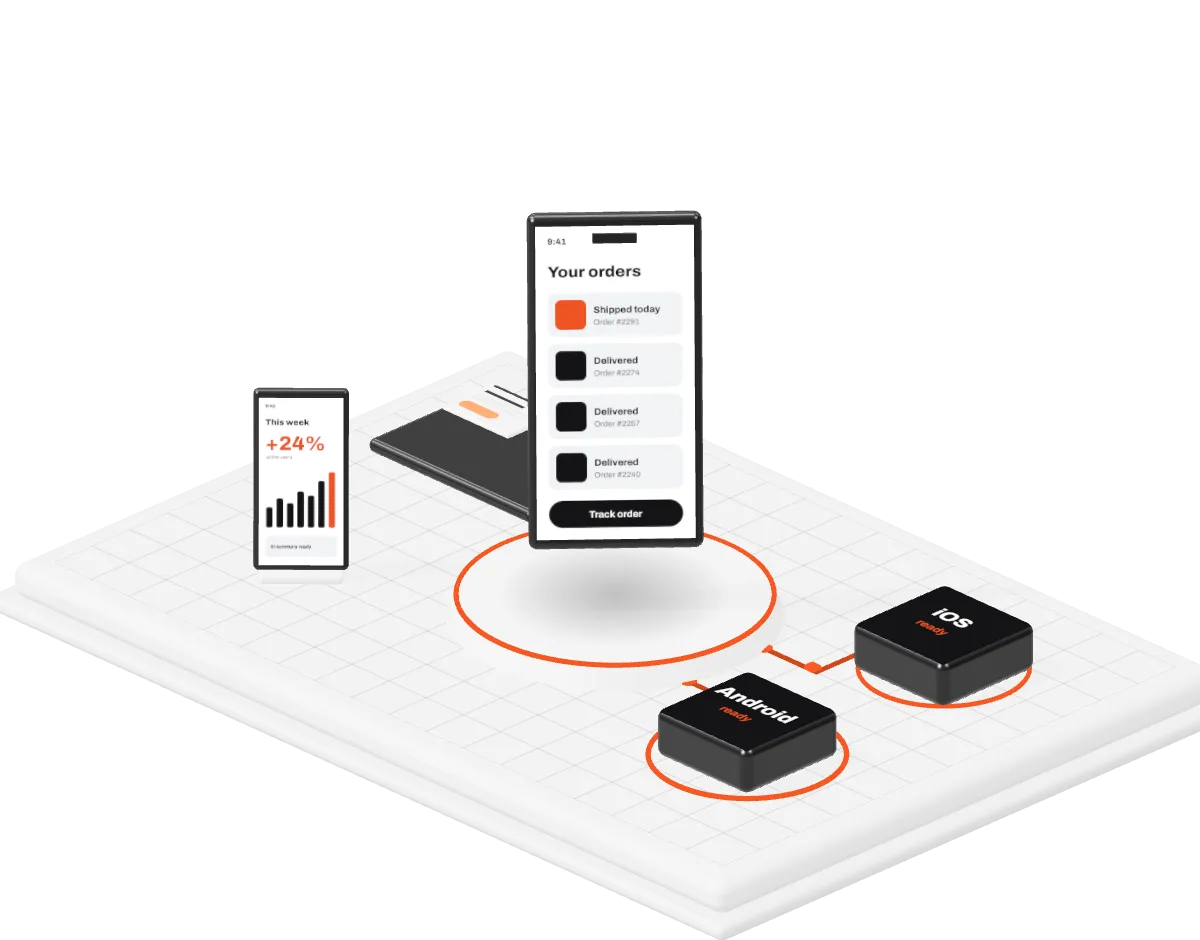
We design and build cross-platform mobile apps in React Native and Flutter, then take them through App Store and Google Play review. You get one codebase, two native-feeling apps, and a back end and admin panel to run them.
Before building an app, ask whether people will open it more than once. If the answer is no, a fast mobile website may do the job better, and we will tell you so.
Apps earn their place when people use them repeatedly. Typical examples are booking and rebooking, ordering, tracking something, working in the field, getting rewarded for loyalty, or needing the phone's camera, location, notifications or offline access. If your users will visit once a year, a well-built mobile web experience is cheaper, easier to find on Google and does not need an app store download.
When an app is the right answer, we usually recommend a cross-platform framework. React Native and Flutter now deliver smooth, native-feeling apps for the vast majority of business use cases from a single codebase. That roughly halves the work of building and maintaining separate iOS and Android apps. We use native Swift or Kotlin modules where a feature genuinely needs them.
The parts people forget to budget for
An app is more than screens. It needs a back end with an API, an admin panel for your staff, push notification infrastructure, analytics, crash reporting, app store listings and screenshots, and someone to handle store review feedback. All of that is in our scope from the start, so there are no surprises in week ten.
What we build
Customer apps
Booking, ordering, loyalty and account apps for service businesses, restaurants, clinics and retailers, connected to the systems you already use.
Startup and marketplace apps
Two-sided apps with profiles, search, messaging, payments and reviews, built as a focused MVP and ready to grow.
Field and staff apps
Offline-capable apps for technicians, drivers and inspectors: job lists, forms, photos, signatures, barcode scanning and GPS.
Companion apps for SaaS
Mobile versions of your web product that share its API and design system, with push notifications for what matters.
AI in the app
On-device or cloud AI for photo recognition, document scanning, voice notes, smart search and in-app assistants.
App rescue and updates
Taking over existing apps: dependency upgrades, crash fixes, store compliance updates and performance work.
From idea to both app stores
Discovery and prototype
User journeys, feature priorities and a clickable prototype you can test on your own phone before development starts.
Design system
Screens and components designed for both platforms, following Apple and Google guidelines where they differ.
Build and test
Sprints with test builds delivered to your phone through TestFlight and Google Play internal testing every two weeks.
Store launch and support
Store listings, review submission, release monitoring and a support period, with analytics showing how people actually use the app.
Technology
Cross-platform
- React Native
- Expo
- Flutter
- TypeScript
- Dart
Native when needed
- Swift
- Kotlin
- Native modules for camera, Bluetooth and payments
Back end and services
- Node.js
- Python
- Firebase
- Supabase
- PostgreSQL
- Stripe
- RevenueCat
- OneSignal / FCM
Quality and release
- Automated tests
- Sentry
- TestFlight
- Google Play Console
- Expo EAS
- Fastlane
Common questions
React Native or Flutter: which is better?
Both are mature and suitable for most business apps. React Native is a natural fit when your team or web product already uses React and TypeScript. Flutter is excellent for highly custom interfaces and consistent rendering across devices. We recommend one per project based on your existing stack and who will maintain the app.
How much does it cost to build a mobile app?
It depends on the number of screens and user types, offline needs, integrations and the back end, so we provide a fixed written quote after scoping rather than a price list. Building one cross-platform app instead of two native apps is usually the single biggest saving available.
How long does app development take?
A focused first release typically takes 10 to 16 weeks including design, back end, testing and store submission. Apple and Google review usually adds a few days, so we plan launch dates with that buffer included.
Do you publish the app to the App Store and Google Play?
Yes. We prepare listings, screenshots and privacy disclosures and handle submission and review responses. The apps are published under your own Apple and Google developer accounts, so you own them.
Can you add AI features to our app?
Yes. We build features such as photo recognition, document scanning, voice-to-text, smart search and chat assistants, running on-device where privacy or speed matters, or in the cloud for heavier models.
Related services
Web apps and SaaS
MVPs, SaaS platforms, portals and internal tools.
AI development
Assistants, copilots and AI features built on your own data.
Website design
Fast business websites built to rank and convert.
AI automation and agents
Agents that take repetitive work off your team, with a human in the loop.
Thinking about an app?
Tell us what users will do with it. On a free call we will tell you honestly whether an app or a mobile website is the better first step, and what each would involve.